
Today, viewers are surrounded by terms like satellite TV, IPTV, and OTT streaming, which often sound confusing, especially to beginners trying to choose the right option for their home.
Many people end up subscribing to a service without fully understanding how it works, only to realize later that it does not match their viewing habits, internet quality, or budget.
The problem is not the lack of options, but the lack of clarity around what each type of TV service actually offers.
This guide explains the four main types of TV services, Cable TV, Satellite TV, IPTV, and OTT, in a simple, practical way.
Instead of focusing on brands or promotions, it breaks down how each service works, who it is best suited for, and where its limitations lie.
Why Understanding TV Service Types Matters?
Before comparing prices or channel lists, it is important to understand the technology behind each TV service.
The way content reaches your screen affects reliability, picture quality, flexibility, and long-term cost.
Two services may look similar on the surface, but work very differently in real-life use. Knowing these differences helps you avoid overpaying, frustration, and frequent service changes.
Types of TV Services Explained (Cable, Satellite, IPTV, OTT)
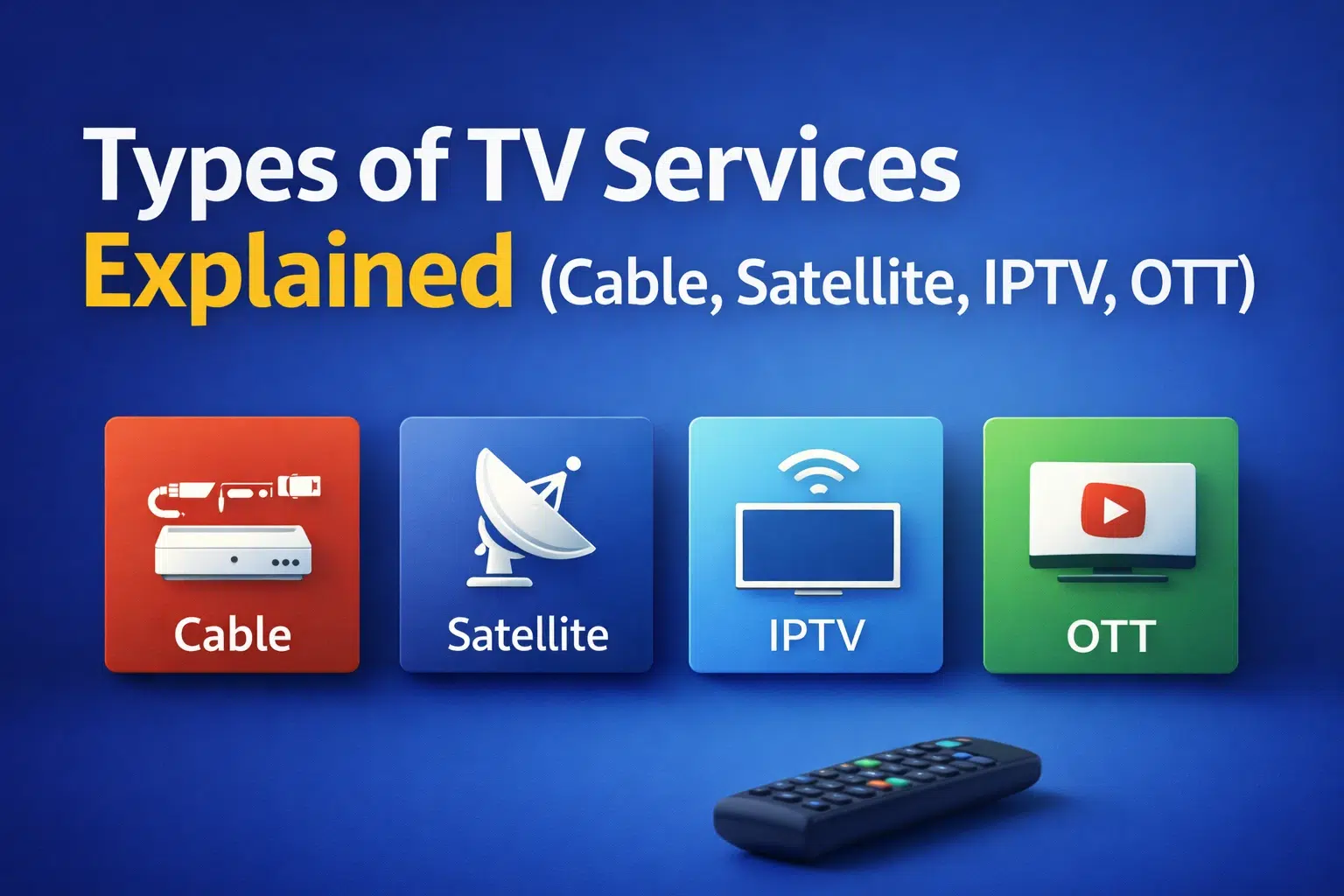
Television services today work in very different ways, even though they all deliver content to the same screen.
What has changed over time is not just the number of channels, but the technology used to deliver those channels.
Because of this, many viewers find it difficult to understand why one service behaves differently from another, even when they appear similar on the surface.
Some TV services rely on physical infrastructure such as cables or satellite dishes, while others depend entirely on the internet.
These differences affect reliability, picture quality, flexibility, and how much control viewers have over what they watch and when they watch it.
Without understanding these basics, it is easy to choose a service that does not match daily viewing habits.
Each type of TV service has its own strengths and limitations. Some are better suited for live programming like news and sports, while others focus on on-demand content and portability.
Internet quality, location, and ease of use also play a major role in determining which option works best for a household.
The sections below explain the four main types of TV services used today: Cable, Satellite, IPTV, and OTT, by focusing on how each one works in practice and who it is best suited for.
This makes it easier to compare options and choose a service based on real needs rather than assumptions or trends.
1. Cable TV: The Traditional Wired Service
Cable TV is one of the oldest and most widely used television services in the USA. It delivers channels to homes through physical cables, usually coaxial or fiber-optic, installed by a cable provider.
Once connected, TV signals travel directly from the provider’s network to your home. A set-top box decodes these signals and displays channels on your television. Cable TV does not depend on the internet to function, which is one of its biggest strengths.
Cable TV is known for reliability, especially for live programming such as news and sports. It also provides easy access to local channels and regional content. For many households, especially families and seniors, cable TV remains familiar and simple to use.
However, cable TV often comes with higher monthly costs, long-term contracts, and additional fees for equipment. Flexibility is limited compared to newer services.
2. Satellite TV: Wide Coverage Without Cables
Satellite TV works very differently from cable TV. Instead of using physical cables, it delivers TV signals from satellites orbiting the Earth directly to a dish installed at your home.
The satellite dish receives signals and sends them to a receiver connected to your TV. This system allows satellite TV to reach areas where cable infrastructure is unavailable, including rural and remote regions.
Satellite TV offers a wide range of channels and strong nationwide coverage. It can be a good option for homes that cannot access cable or reliable internet.
However, satellite TV has some drawbacks. Signal quality can be affected by weather conditions such as heavy rain or snow.
Installation is more complex, and long-term contracts are common. Like cable TV, satellite services can also be expensive over time.
3. IPTV: Internet-Based TV with Structure
IPTV stands for Internet Protocol Television. Unlike cable or satellite TV, IPTV delivers television content over the internet, but in a more structured and controlled way than typical streaming.
With IPTV, channels are delivered through a private network managed by a service provider. This often includes live TV channels, on-demand content, and interactive features.
IPTV services are commonly offered by internet service providers as part of bundled packages.
Because IPTV uses managed networks, it can offer stable picture quality and consistent performance when paired with a strong internet connection. It often feels similar to cable TV but with added digital features.
The main limitation of IPTV is its dependence on the quality of the internet. Without a stable connection, performance may suffer. Availability can also be limited depending on location and provider.
4. OTT: Over-the-Top Streaming Services
OTT, or Over-the-Top TV, refers to streaming services that deliver content directly over the public internet without relying on traditional TV infrastructure.
OTT services allow users to watch content through apps on smart TVs, streaming devices, smartphones, tablets, and computers.
Content is usually available on demand, though some OTT platforms also offer live TV channels.
This type of TV service has become extremely popular due to its flexibility. Viewers can watch what they want, when they want, and on multiple devices. Most OTT services operate on monthly subscriptions without long-term contracts.
However, OTT services depend entirely on internet quality. Subscribing to multiple platforms can also increase monthly costs if not managed carefully.
Key Differences Between Cable, Satellite, IPTV, and OTT
While all four services provide television content, their differences become clear in daily use.
Cable and satellite TV follow fixed schedules and are strongest in live programming. IPTV sits somewhere in between, offering structured channels through the internet. OTT focuses on flexibility and on-demand viewing.
Understanding these differences helps match the service to your lifestyle rather than forcing your habits to fit the service.
Which TV Service Is Best for You?
There is no single “best” TV service for everyone. The right choice depends on several factors.
Cable TV works well for households that prioritize live news, sports, and reliability. Satellite TV suits areas with limited cable or internet access. IPTV fits users who want a cable-like experience through the internet. OTT services are ideal for viewers who prefer on-demand content and flexible viewing.
Many households combine services, using OTT for entertainment while keeping basic cable or IPTV for live channels.
Common Mistakes When Choosing a TV Service
Many people choose TV services based only on promotions or channel numbers. Others underestimate the importance of internet quality or overcommit to long-term contracts.
Another common mistake is assuming newer services automatically replace older ones. In reality, each service type has its own strengths and weaknesses.
Taking time to understand these differences prevents frustration and unnecessary expenses.
Conclusion
Understanding the types of TV services, Cable, Satellite, IPTV, and OTT, is the first step toward making a smarter viewing decision.
Each service works differently and serves different needs. Cable and satellite focus on live programming and coverage, IPTV blends structure with internet delivery, and OTT emphasizes flexibility and on-demand access.
By understanding how each service operates and what it offers, you can choose a TV setup that fits your lifestyle, budget, and long-term expectations rather than following trends or marketing claims.
Frequently Asked Questions
Q. What is the main difference between IPTV and OTT?
Ans: IPTV uses a managed network provided by a service provider, while OTT uses the public internet and works independently of traditional TV infrastructure.
Q. Is satellite TV still relevant today?
Ans: Yes, especially in rural areas where cable and high-speed internet are limited.
Q. Can I replace cable TV completely with OTT?
Ans: Many people do, but it depends on your need for live channels, sports, and local programming.
Q. Does IPTV require fast internet?
Ans: Yes. A stable and reasonably fast internet connection is essential for IPTV services.
Read Also:
How Parental Controls Work on TV Services
How to Set Up Streaming TV on Smart TV
How to Set Up Cable TV at Home